THE SHAPE of a diamond
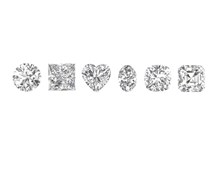
The round brilliant cut diamond
The irst one from the left in the picture above.
The classical and most popular is the round brilliant cut diamond with 58 facets.
The many facets make this diamond shape the most sparkling of them all! A round brilliant cut diamond is always in fashion, always right, and works perfectly well with all designs.
The princess-cut diamond
The second one from the left in the picture above.
Princess-cut diamonds are traditionally square, but lately they also come rectangular. It is important to be extra careful and study the certificate well to ensure that there are no inclusions such as needles or feathers near the sharp corners of the diamond. The corners are a bit fragile. Always choose a design with prongs that protect the four angles of the diamond.
The heart-shaped diamond
The third one from the left in the picture above.
What could be a more romantic choice than a heart-shaped diamond on your finger and around your neck.
The oval diamond
The third one from the right in the picture.
An oval-cut diamond is similar to a round brilliant-cut diamond, but oval. Some like it longer and some like it rounder, but make sure it has no bow-tie. The certificate will not give any information about this phenomenon, only your eyes. In the middle of an oval (and sometimes also in a marquise, pear, and radiant cut diamond), a black bow-tie may appear.
This is not an inclusion, but rather an illusion; therefore, the certificate will not tell. The light is not reflected from the pavilion; it passes through and away, and the eyes see dark facets.
The cushion-cut diamond
The second one from the right in the picture.
The cushion cut diamond has round corners and can be both square and rectangular. A cushion-cut diamond is perceived as smaller than a round one, even though both have the same carat weight. Cushion-cut diamonds are slightly less expensive than round diamonds and are very beautiful to set in a diamond halo.
The radiant-cut diamond
The first one from the right in the picture above.
A radiant cut diamond is a crossover between an emerald cut and a princess cut diamond with soft corners. It sparkles a lot and is a rare and unique choice.
The emerald cut diamond
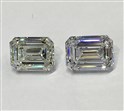
This shape was originally developed for emeralds, hence the name, emerald cut diamond. At first glance, the baguette-cut diamond and the emerald-cut diamond may look the same. They are not! The emerald cut diamond has cut corners and many more facets, and thus sparkles more. The baguette-cut diamond is usually more elongated. When you look deep into this gorgeous emerald cut diamond, it almost looks like there are little mirrors in it. It needs to be vs1 or better, as all inclusions are easily visible. To allow this diamond to light up all days of your week, give it some love and care once every Friday (or Saturday, or Monday, choose any day you like:)). This diamond shape needs to be kept perfectly clean to continue to seduce you. A soft brush, warm water, and a little dish soap, that´s all.
A clean and white emerald cut diamond is incredibly beautiful and doesn´t require company. If you want to wear two rings, it's elegant to match it with a neat eternity ring with baguette-cut diamonds that don't demand too much attention.
The Navette (or Marquise) cut diamond
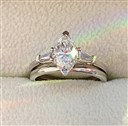
It looks big in comparison to other diamond shapes. It is a brilliant cut with 58 facets. It is oval in shape with sharp corners. The diamond makes an excellent centre stone in a ring accompanied by a drop-cut diamond on each side, with the wider part of the drop facing the centre stone.
The shape of the centre-cut diamond makes the finger look longer. Each end of the diamond should be protected by prongs.
The drop-shaped diamond
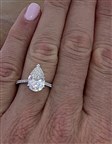
The drop- or pear-shaped diamond, like other brilliant-cut diamonds, has 58 facets. It has lately become a very popular choice for an engagement ring. A drop-shaped diamond is very elegant as a pendant.
The rose-cut diamond
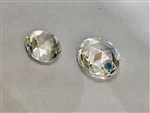
An unusual cut that makes the diamond look like a rosebud.
The lower part of the diamond (pavilion), which is pointed on a round diamond, is rounded or even flattened on a rose cut diamond to give the diamond the largest possible table. This diamond shape has very few facets, and therefore doesn´t sparkle very much. The light goes through the diamond and does not bounce back because there is no pavilion to bounce into.
Why this shape, you wonder? I would say that there are four reasons to go for this diamond shape.
The first is that it is a very pretty shape with an understated elegance.
The second reason is that you can be extra creative when making the setting; any side of the diamond can be turned up. It is perfect in a vintage ring, which quite often has a low setting.
The third reason is that you get a diamond that looks very big (it's all table, nothing underneath) for not much money. A brilliant cut round 1 carat diamond has a table of about 6.5mm in diameter, while a rose cut diamond with the same size has a table that is 50% bigger.
The fourth reason is that you are unlikely to meet anyone else who has chosen the same retro-romantic shape.
The baguette-cut diamond
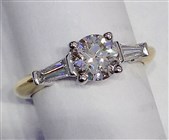
Two taoered baguette-cut diamonds on each side of the center diamond. A baguette cut diamond has steps and inclusions are easy to spot, therefore, it is a good idea to choose a diamond with as few inclusions as your budget allows. Baguette-cut diamonds are traditionally rectangular with pointed corners. Baguette-cut diamonds are often used as side stones to enhance a center stone, as seen in the picture above. This is particularly effective if the baguette-cut diamonds have one wider side (meaning they look like a piece of a cake, triangle) with the wider side turned towards the centre diamond. A baguette-cut diamond with one wider side is called a tapered baguette-cut diamond.
The ASSCHEr cut diamond
Finding the one when it is about an Asscher cut diamond might be time-consuming, since the color should preferably be F or higher, but most importantly, it must be at least vs1. Inclusions are more visible in this type of diamond because it has long and fewer facets in the centre of the diamond. A regular Asscher cut diamond is similar to an emerald cut diamond, but it is square. If you want a nice Asscher cut that sparkles almost as much as a round brilliant cut diamond, you should choose a Royal Asscher Cut. This cut was developed by Joseph Asscher's grandchildren (Joop and Edward). It is an even more beautiful cut than the original Asscher cut, and it has more facets, as many as 77
The 4 C:s
Carat
Colour
Cut
Clarity